Coffeely - Learn about Coffee
- 4.2
- Rating
- 100.00K
- Installs
- Free
- Price

 Analysis by App-foxy
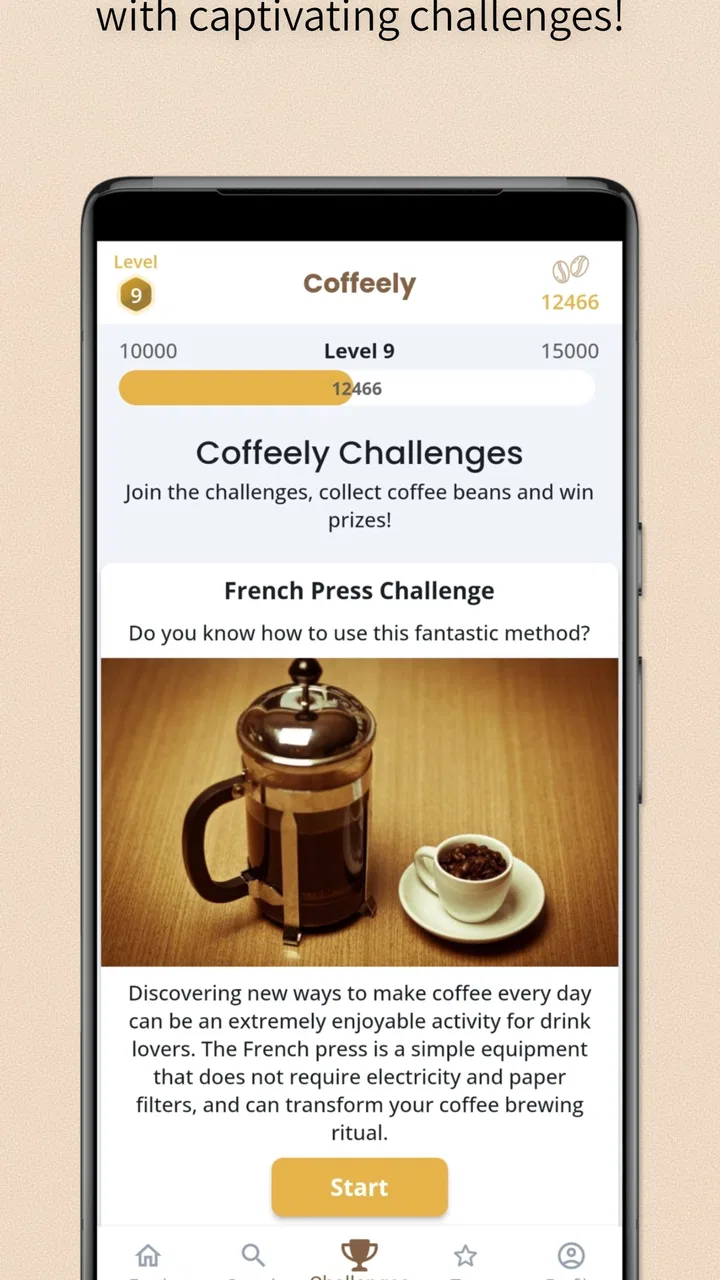
I approached Coffeely as someone who enjoys coffee but does not always know how to describe what is in the cup. It is a free Food & Drink app from Coffeely, designed around learning and self-testing rather than ordering drinks, locating cafés, or replacing a brewing timer. That distinction matters: the useful part is the chance to build coffee knowledge through active challenges, not simply scroll through a collection of facts.
The app’s central promise is easy to understand. You use it to challenge yourself and gradually become more comfortable with coffee terminology and ideas. In my experience, that makes it a better fit for a curious beginner than for somebody looking for a detailed professional reference. It gives you a reason to pay attention, make a choice, and notice what you still do not know.
It is available at no upfront cost, carries a Teen content rating, and has passed the threshold of one hundred thousand installs. Its average score is 4.2 from around one thousand two hundred ratings, which suggests that many people find the basic learning concept worthwhile. I would still treat those numbers as a starting point rather than a guarantee, because an educational app can feel very different depending on whether you prefer quick quizzes or long explanations.
You May Also Like

 Blood Strike: 2.5 Anniversary
Blood Strike’s Loadouts Turn Every Drop Into a Tactical Gamble
A close look at Blood Strike’s custom loadouts: how fast access to signature weapons reshapes its battle royale rhythm, rewards preparation, and narrows the gap between fights.

 Pandora - Music & Podcasts
Pandora’s Music Is Easy to Start, but Harder to Recover
Pandora’s strength is its low-effort path from a seed to a station. Its weak spot is how much confidence it asks you to place in connection, setup, and quiet recovery.

 8 Ball Pool
 Is Built on Rivalries, Rematches, and Routine
A close look at the rivalries, rematches, shared routines, and unanswered safety questions that turn a quick pool match into a persistent mobile community.

 Samsung Music
’s Quiet Strength Is Playing What You Already Own
Its reach comes less from spectacle than from dependable access to a personal library. That simplicity is both the app’s strongest retention engine and its ceiling.

 AccuWeather: Weather Radar
AccuWeather Review: A Quick, Clear Forecast for Everyday Decisions
For everyday plans, the best forecast is the one you can understand quickly. AccuWeather makes rain timing, radar, and local conditions easy to act on, with a few trade-offs.

 Hill Climb Racing
Why Hill Climb Racing Still Turns Crashes Into One More Run
A tiny car, a bumpy hill and one more upgrade: Hill Climb Racing keeps resurfacing because its simple chaos makes every near-miss feel personal.
More From Our News Desk
View All News


Getting from the first launch to a useful coffee habit
I’d use the first session to find out whether Coffeely’s challenge-based approach fits how I like to learn, rather than trying to master coffee vocabulary all at once. I’d answer from memory, then keep one question to explore over a cup or café visit; that small loop makes the learning feel practical. Next, I’d look at how to turn those first few minutes into a habit that lasts.
What to expect before you begin
The first thing to understand is that this is a learning companion, not a café utility. If you want nearby shop recommendations, a shopping list for beans, a brewing calculator, or a replacement for a coffee machine manual, this is probably not the right download. Its appeal is more personal: it encourages you to test your understanding and become more confident when coffee topics come up.
I like that focus because coffee can be intimidating. Menus often use words that sound obvious to experienced drinkers but are confusing when you are just starting out. An app built around challenges can make those terms less passive. Instead of reading a definition once and forgetting it, you have to decide what you think the answer is. That small act of commitment makes the learning process feel more memorable.
At the same time, I would not expect Coffeely to turn a complete beginner into a trained barista by itself. A quiz-style approach is strongest when it gives you a framework for curiosity. After learning a term, you may still need to taste different coffees, ask a barista, or consult a more specialized source to understand how the idea appears in real life.
The current version is 6.32.04, and the app supports devices running Android 6.0 or later. That makes it accessible to people using older compatible Android phones, although the experience can naturally depend on the screen, speed, and software condition of the device you use. The developer is Coffeely, and the app has been available since December 4, 2016, so it is not a brand-new experiment.
How I would approach the first setup
For a first-time user, I recommend opening the app when you have a few uninterrupted minutes rather than treating it like background entertainment. The goal of the first session should be simple: understand how a challenge works, complete one honestly, and identify one coffee idea you want to remember. You do not need to know coffee vocabulary in advance to begin.
Do not try to protect your score by guessing what sounds sophisticated. A wrong answer is more useful when it shows you exactly where your knowledge is thin. I found that answering from memory first creates a clearer learning moment than immediately searching for the correct choice. If the app presents an explanation after a challenge, read it even when you answered correctly; knowing the answer and understanding the reason are not always the same thing.
A practical setup routine is to keep a small note on your phone or in a notebook. Write down only the terms that you confuse, not every word you see. For example, if two preparation methods seem similar, record the difference in your own language. This turns a short app session into a personal revision list and avoids the common problem of completing challenges without retaining anything.
Because the app includes in-app purchases ranging from $1.99 to $19.99 per item, I would also make a deliberate choice about spending before using it regularly. The free entry point is useful for deciding whether the learning style suits you. There is no reason to buy anything immediately just because you are curious about the app. First establish that you enjoy returning to the challenges and that they are helping you notice coffee details in everyday life.
The first meaningful success is not a perfect score
My definition of a successful first action is completing one challenge, reviewing the result, and using one new idea outside the app. That might mean looking at a bag of beans and paying attention to its wording, asking a café worker a more specific question, or noticing that two drinks are prepared differently. The app becomes more valuable when it changes what you observe away from the screen.
Try this workflow: begin without searching for answers, pause after each response, and explain to yourself why you chose it. When the result appears, compare your reasoning with the explanation. Then choose one point to revisit later. This is more effective than racing through a long session because it gives each question a place in your memory.
A realistic everyday use case is a weekend coffee run with a friend. Before leaving, spend a short session testing yourself on the app. At the café, instead of ordering the most familiar drink automatically, ask about one unfamiliar term or compare the description of two options. You are not trying to sound like an expert. You are using the app to make a normal purchase more interesting and to connect an abstract lesson with a real cup.
Another useful routine is to open it before buying beans. If a label includes a word you recognize from a challenge, treat that as a prompt to investigate rather than proof that the coffee will suit you. Coffee taste is personal, and vocabulary alone cannot predict whether you will enjoy a particular roast or preparation. The app can improve your questions, but your palate still has the final say.
Where new users may become confused
The phrase “coffee connoisseur” can create the wrong expectation. You do not need to approach Coffeely as a test of status. Coffee knowledge is not a competition against people who know more terms. If you treat every incorrect answer as failure, the app may become frustrating quickly. I got more from it when I treated uncertainty as the actual material being studied.
Another possible source of confusion is the difference between recognizing a definition and applying it. You may remember a word in a challenge but still be unsure how it affects flavor, texture, equipment, or ordering. That is normal. When this happens, do not simply repeat the same question until the answer feels familiar. Instead, connect the term to a real conversation or tasting experience. The extra step is what turns recognition into usable knowledge.
It is also worth separating the app’s learning process from personal preference. A correct answer does not mean one coffee style is universally better. If a challenge helps you understand a preparation method, that does not require you to enjoy the resulting drink. I appreciate this distinction because coffee discussions often mix technical facts with taste judgments, and beginners can easily assume that expertise means liking the same things as everyone else.
The purchase model may require attention as well. Since the app is free but offers individual in-app purchases, I would avoid judging the whole experience based only on the first few minutes or assuming that every part is included without cost. Explore the free experience first, decide whether the content is genuinely useful to you, and only then consider whether an optional purchase adds enough value for your own learning routine.
There is a further limitation for people who want a linear course. Challenge-based learning can feel scattered if you expect a textbook-style path from basic concepts to advanced subjects. I would use a notebook or a simple list to create your own order. Group unfamiliar terms by the questions they help you answer: how coffee is prepared, how it may taste, how it is described, and how it differs from another option. That personal structure makes the app easier to use as a beginner.
How it compares with familiar alternatives
Compared with reading coffee articles, Coffeely’s strongest difference is participation. Articles are better when you want a detailed explanation in one sitting or need to look up a specific subject. The app is more convenient when you want to test whether you actually remember something. I would use an article for depth and Coffeely for recall, rather than expecting either one to do both jobs perfectly.
Compared with watching coffee videos, the app is less dependent on having time to follow a demonstration. A video can show technique, equipment, and visual details that a challenge cannot replace. On the other hand, videos are easy to watch passively. Coffeely asks you to make decisions, which is useful when your problem is not a lack of exposure but a lack of confidence.
Compared with a café class or a conversation with an experienced barista, the app is more private and easier to revisit, but it cannot respond to your exact questions in the moment. A human can taste with you, correct a misunderstanding, and adapt an explanation to your preferences. If you are choosing equipment, changing a brewing routine, or trying to understand why a cup tastes unpleasant, personal guidance will usually be more valuable.
Compared with a simple notes app, Coffeely offers a reason to practice rather than leaving you responsible for creating every exercise. Notes are better for recording your own tasting impressions, while the app is better for prompting recall. The most effective combination is to use the challenge to identify a topic and your notes to connect it with what you actually drink.
Who will get the most from it
I would recommend Coffeely to a beginner who wants a friendly way to explore coffee language, a regular café visitor who wants to order with more confidence, or a hobbyist who enjoys short self-tests. It can also suit someone who has read about coffee before but discovers that the information disappears when they need to explain it. The active format gives those loose facts a little more structure.
It is less suitable for a professional seeking a complete training curriculum, a home brewer who mainly needs precise recipes, or anyone looking for local purchasing and café tools. It may also disappoint users who dislike quizzes or who want every topic arranged in a formal lesson sequence. Those people may be better served by a specialized course, a brewing reference, or direct instruction.
For families, the Teen content rating is an important part of the decision. I would consider the intended age guidance before handing the device to a younger child, even though the subject itself is ordinary coffee education. The rating is a reminder to use the app in a way that matches the age expectations of the person using it.
A better second-week routine
After the first successful session, resist the temptation to measure progress only by how many challenges you complete. A better sign is whether you can explain one concept in plain language and recognize when it matters. Set a modest rhythm: return when you have a real coffee decision or conversation coming up, then review the terms that connect to it.
One advanced but simple technique is to deliberately revisit questions you got right for the wrong reason. Marking only mistakes misses this hidden weakness. If you guessed correctly, you may not be able to reproduce the reasoning later. During a second pass, ask yourself whether you could explain the answer without seeing the choices. That turns the app from a guessing game into a stronger memory exercise.
Another useful trade-off is choosing breadth or depth for each session. If you are new to coffee, cover several unfamiliar ideas briefly and note which ones deserve more attention. If you already know the basics, spend longer unpacking confusing distinctions instead of chasing a higher number of correct answers. The app can support both approaches, but the learning result depends on how intentionally you use it.
I would also keep your real-world observations separate from the app’s answers. Record what you tasted, how you prepared it, and whether you liked it. Then compare that experience with the concepts you studied. This prevents technical vocabulary from taking over your judgment and helps you discover which parts of coffee knowledge actually improve your enjoyment.
My final recommendation
Coffeely works best as a low-pressure doorway into coffee education. It gives beginners a concrete first step: answer a challenge, learn from the result, and carry one idea into a café, a conversation, or the next cup at home. That is more useful than simply collecting definitions, and it explains why the app has built a solid audience over time.
My honest reservation is that it should not be treated as a complete coffee course or a practical brewing manual. The challenge format can leave gaps, and the optional purchases mean I would explore the free experience carefully before spending money. If you need detailed technique, personalized feedback, or shopping and café features, another tool will serve you better.
For someone who wants to feel less lost when coffee terminology appears, however, I think it is worth trying. Start with one honest challenge, keep track of the concepts that genuinely confuse you, and connect them to coffee you can taste in real life. The most valuable result is not sounding like a connoisseur; it is becoming more curious and more confident with every cup.
FAQs for Coffeely - Learn about Coffee
01What is Coffeely - Learn about Coffee?
Coffeely - Learn about Coffee is an educational app designed for people who want to understand coffee beyond simply drinking it. It introduces topics such as coffee origins, bean varieties, roasting, brewing methods, flavor profiles, and basic tasting concepts. The app is suitable for beginners, casual coffee drinkers, and enthusiasts who want a convenient way to build their coffee knowledge on a mobile device.
02Is Coffeely suitable for complete beginners?
Yes. Coffeely is presented in a beginner-friendly way, making it useful even if you do not know the difference between Arabica and Robusta or have never used a manual brewing method. The information is organized into accessible lessons and explanations rather than assuming professional barista knowledge. More experienced coffee drinkers may also appreciate it as a quick reference for reviewing terminology and brewing fundamentals.
03What topics can users learn about in Coffeely?
The app covers several important areas of coffee education, including bean origins, processing methods, roasting levels, grind size, brewing techniques, tasting vocabulary, and factors that influence flavor. Depending on the version and available content, users may also find information about coffee preparation and comparisons between popular brewing styles. It is best viewed as an introductory learning tool rather than a replacement for professional barista training.
04Does Coffeely require an internet connection or a subscription?
The exact requirements can depend on the app version, device, and the developer’s current business model. Some educational content may be available after installation, while other features could require an internet connection, account access, or an in-app purchase. Before downloading, check the official Google Play Store or App Store listing for the latest information about subscriptions, advertisements, offline access, and any locked lessons or premium features.
05Is Coffeely worth downloading for coffee enthusiasts?
Coffeely can be worth downloading if you enjoy coffee and prefer learning through short, organized mobile content. It offers a convenient introduction to subjects that are often confusing when researched separately, such as roasting, origin, extraction, and flavor notes. However, users seeking advanced brewing recipes, live instruction, equipment recommendations, or professional certification may need to combine the app with hands-on practice and more specialized resources.
Pros
- Clear lessons make coffee basics easy for beginners to understand.
- Covers beans
- brewing methods
- flavor notes
- and coffee preparation.
- Useful reference for exploring unfamiliar coffee terms and styles.
- Short learning format makes it convenient to study in spare moments.
- Can help users make more informed choices when buying coffee.
Cons
- Advanced coffee enthusiasts may find the content too introductory.
- Some information may feel simplified compared with specialist coffee courses.
- Learning value depends on how regularly users complete the lessons.
- Not a substitute for hands-on brewing practice or tasting experience.
- Coffee recommendations may not suit every user’s personal preferences.

Coffeely - Learn about Coffee
Gallery